SentinelOne Review 2027: AI-Powered Endpoint Protection That Means Business
 William Marshal
Posted On October 20, 2026
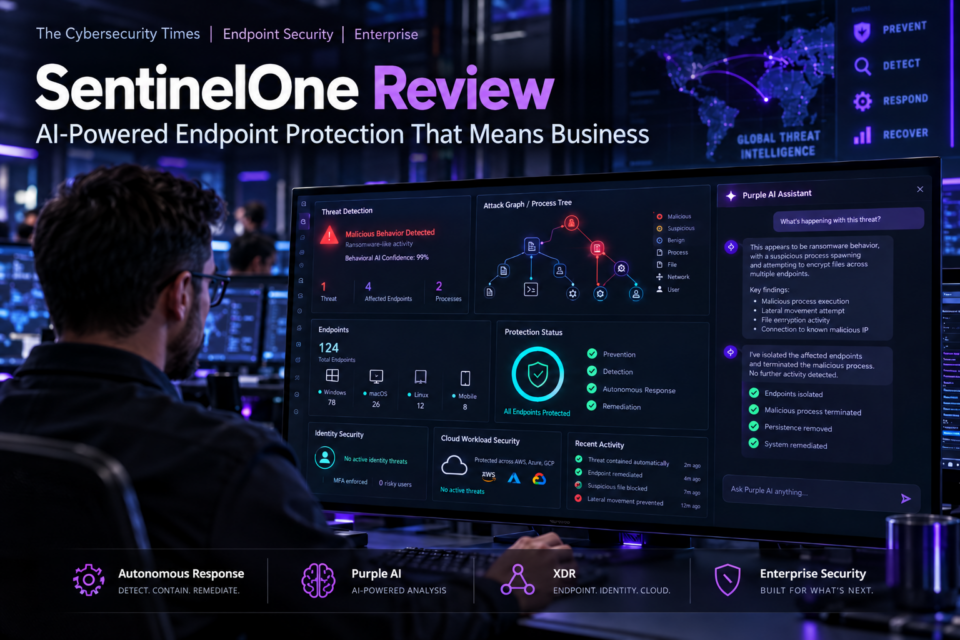
SentinelOne has spent the better part of a decade positioning itself as the autonomous endpoint protection platform that doesn’t need humans in the loop to stop threats. Bold claim. And increasingly, one it can back up.
Founded in 2013 and publicly listed since 2021, SentinelOne has grown from a scrappy EDR challenger into a legitimate enterprise security powerhouse, now competing directly — and credibly — with established giants like CrowdStrike Falcon. Its Singularity Platform sits at the core of everything the company does: a unified agent that handles EPP, EDR, XDR, identity security, and cloud workload protection from a single console.
We spent several weeks testing SentinelOne Singularity across multiple tiers, stress-testing its autonomous response capabilities, evaluating its threat intelligence depth, and comparing it point-by-point against CrowdStrike Falcon — its most direct and formidable competitor. What we found is a platform that genuinely earns its reputation in several critical areas while falling short in a handful of others.
Key Features
1. Singularity AI Engine (Purple AI)
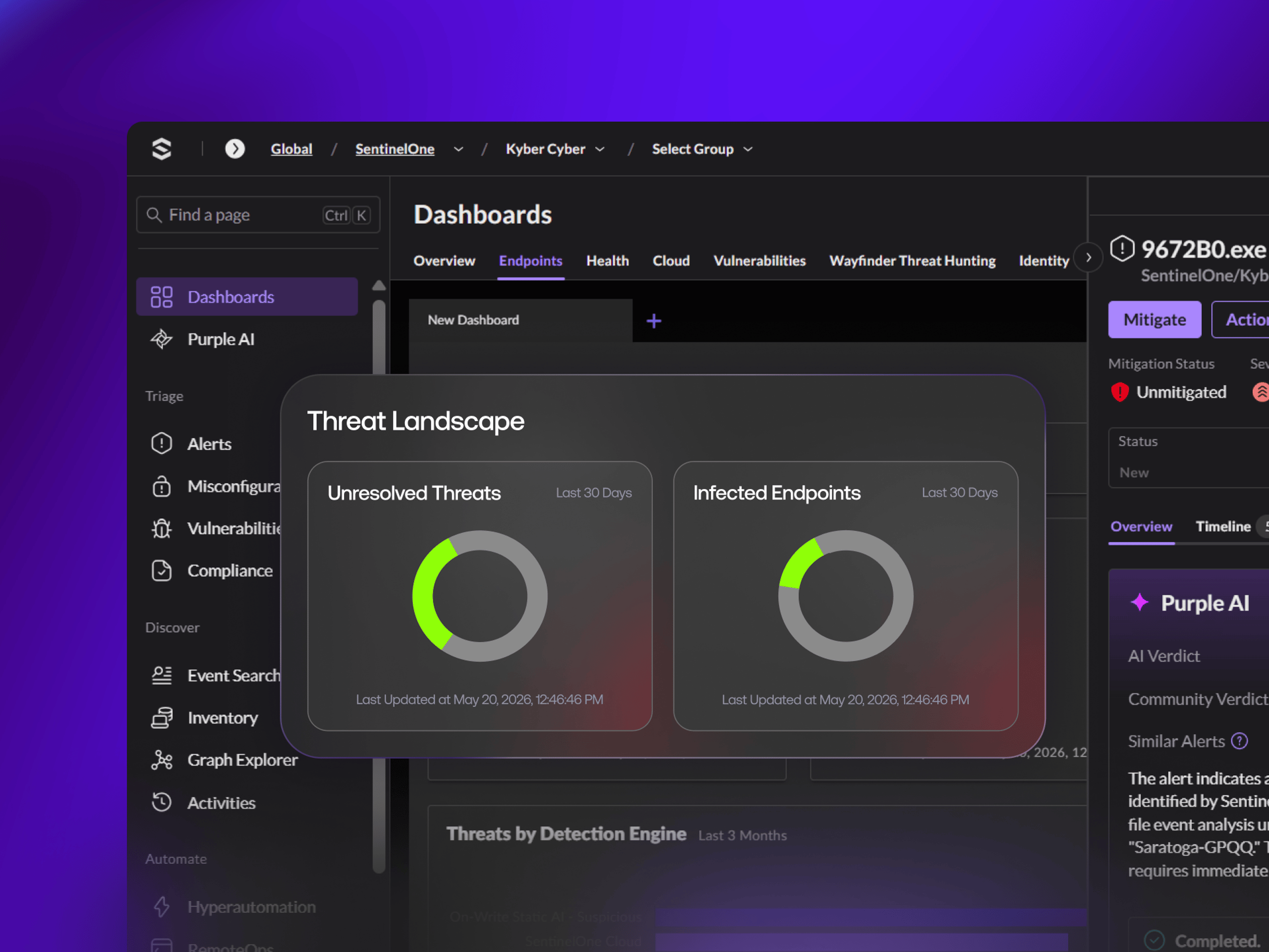
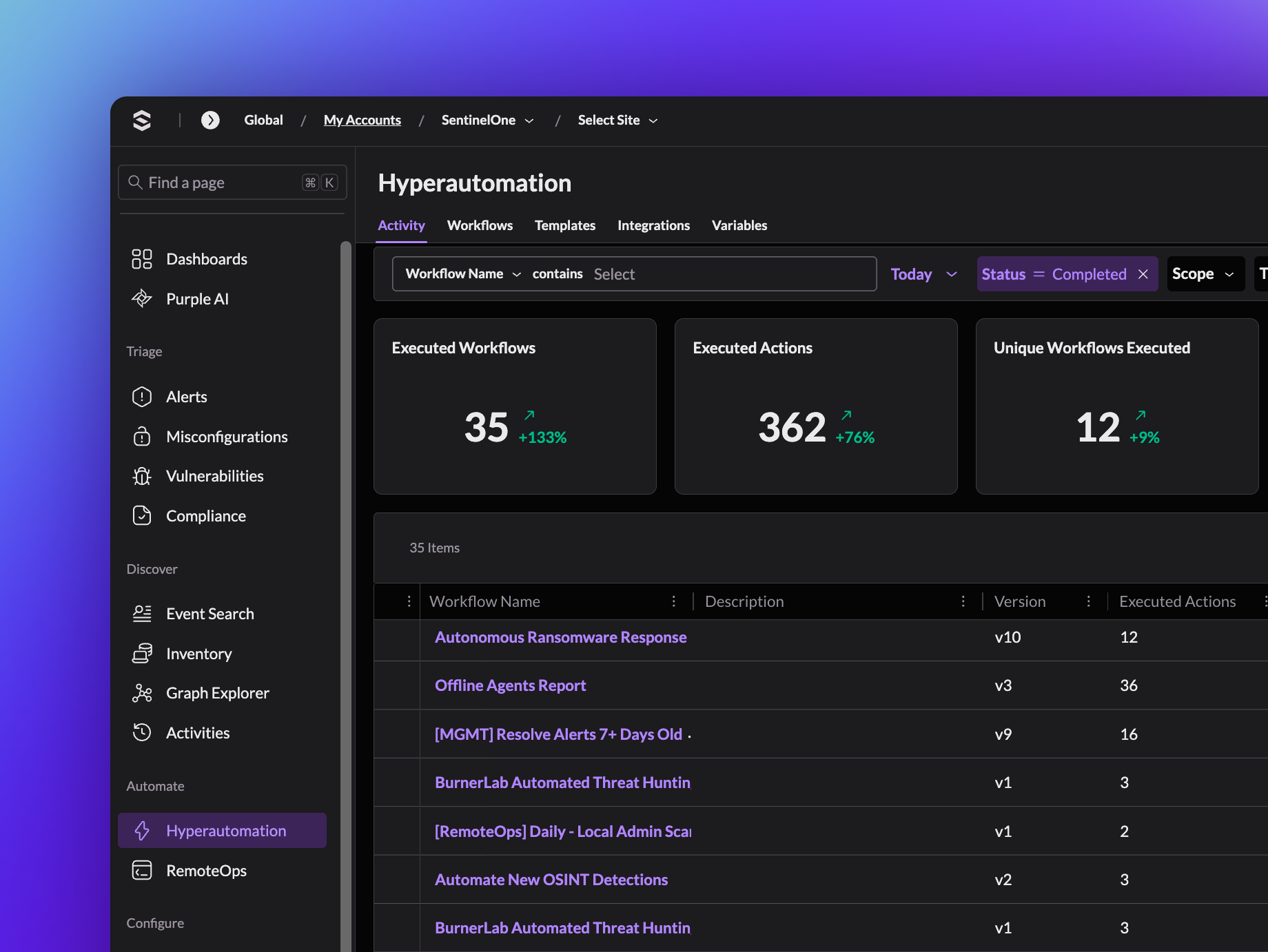
SentinelOne’s headline innovation is Purple AI — a generative AI security analyst baked directly into the platform. It allows security teams to query their entire security data lake using natural language. Ask it “show me all lateral movement activity from the past 72 hours involving privileged accounts” and it translates that into a structured hunt query instantly.
This isn’t marketing fluff. Purple AI is genuinely useful for analysts who aren’t threat-hunting experts. It accelerates investigation workflows, surfaces relevant context automatically, and can generate remediation recommendations. The quality of its outputs isn’t perfect — it occasionally surfaces noise alongside signal — but it meaningfully lowers the barrier to sophisticated threat hunting.
Comparison with CrowdStrike: CrowdStrike’s equivalent is Charlotte AI, which similarly offers natural language querying and AI-assisted investigation. Charlotte AI has slightly deeper integration with CrowdStrike’s threat intelligence feeds (Adversary Intelligence), giving it richer contextual outputs. Purple AI edges ahead on interface intuitiveness; Charlotte AI edges ahead on threat context depth. Call it a draw with slight advantage to CrowdStrike on intelligence depth.
2. Behavioral AI Detection (Static + Behavioral Engines)
SentinelOne runs multiple AI engines simultaneously — one for static file analysis and one for behavioral analysis — operating entirely on-device. This is critical: detection does not require cloud connectivity. The on-device model means SentinelOne can detect and respond to threats even on air-gapped or intermittently connected endpoints.
The behavioral engine watches process trees, API calls, memory access patterns, and inter-process communication in real time. It doesn’t rely on signatures, which means zero-day and fileless attacks are within its detection scope. In independent testing by SE Labs (Q3 2023), SentinelOne achieved a 100% total accuracy rating in enterprise endpoint protection — one of only a handful of vendors to do so.
Comparison with CrowdStrike: Falcon also runs a local sensor with behavioral analysis, but its architecture leans more heavily on cloud-based intelligence for enrichment. This means Falcon can be marginally more dependent on connectivity for full capability. In practice, the difference is minimal for most enterprise environments. Both platforms consistently top independent tests. MITRE ATT&CK Evaluations (2023, Turla scenario) showed both performing at elite levels, with CrowdStrike demonstrating slightly higher analytic detection rates; SentinelOne demonstrated stronger prevention-focused results.
3. Storyline Technology
This is one of SentinelOne’s genuinely differentiated features. Storyline automatically correlates every event on an endpoint — processes, files, network connections, registry changes — into a causally linked narrative. Every event gets a Storyline ID, allowing analysts to instantly understand the full attack chain without manually stitching together logs.
When an alert fires, you don’t get an isolated event. You get the complete story: what spawned what, what talked to where, what was modified and when. For incident response teams, this is a significant time-saver. Mean time to respond measurably decreases when you’re handed a complete narrative instead of raw telemetry.
Comparison with CrowdStrike: Falcon’s Process Tree visualization serves a similar purpose and is arguably more mature in its presentation, with richer context around each node. However, CrowdStrike’s correlation requires more manual pivoting in some scenarios where SentinelOne’s Storyline surfaces it automatically. Analysts who have used both tend to prefer Storyline for speed; they prefer Falcon’s process tree for investigative depth.
4. Autonomous Response (Endpoint)
SentinelOne’s autonomous remediation goes beyond quarantine. When configured at maximum autonomy (the “Protect” mode), it can:
– Kill malicious processes
– Quarantine affected files
– Roll back endpoints to a pre-attack state using VSS snapshots (Windows) or equivalent mechanisms on macOS/Linux
– Network-isolate compromised endpoints
– Remove malicious registry keys and persistence mechanisms
The 1-Click Remediation and Rollback feature is something CrowdStrike does not offer natively. If ransomware encrypts files before detection triggers, SentinelOne can restore those files from shadow copies automatically. This is a tangible, practical differentiator — particularly for organizations with limited IR capacity.
Comparison with CrowdStrike: Falcon’s response capabilities are strong — network containment, real-time response shell, file quarantine — but native rollback is absent. CrowdStrike achieves similar outcomes through its Falcon Insight integration and partner ecosystem, but it requires additional tooling or services. SentinelOne wins this category clearly.
5. XDR and Data Ingestion (Singularity Data Lake)
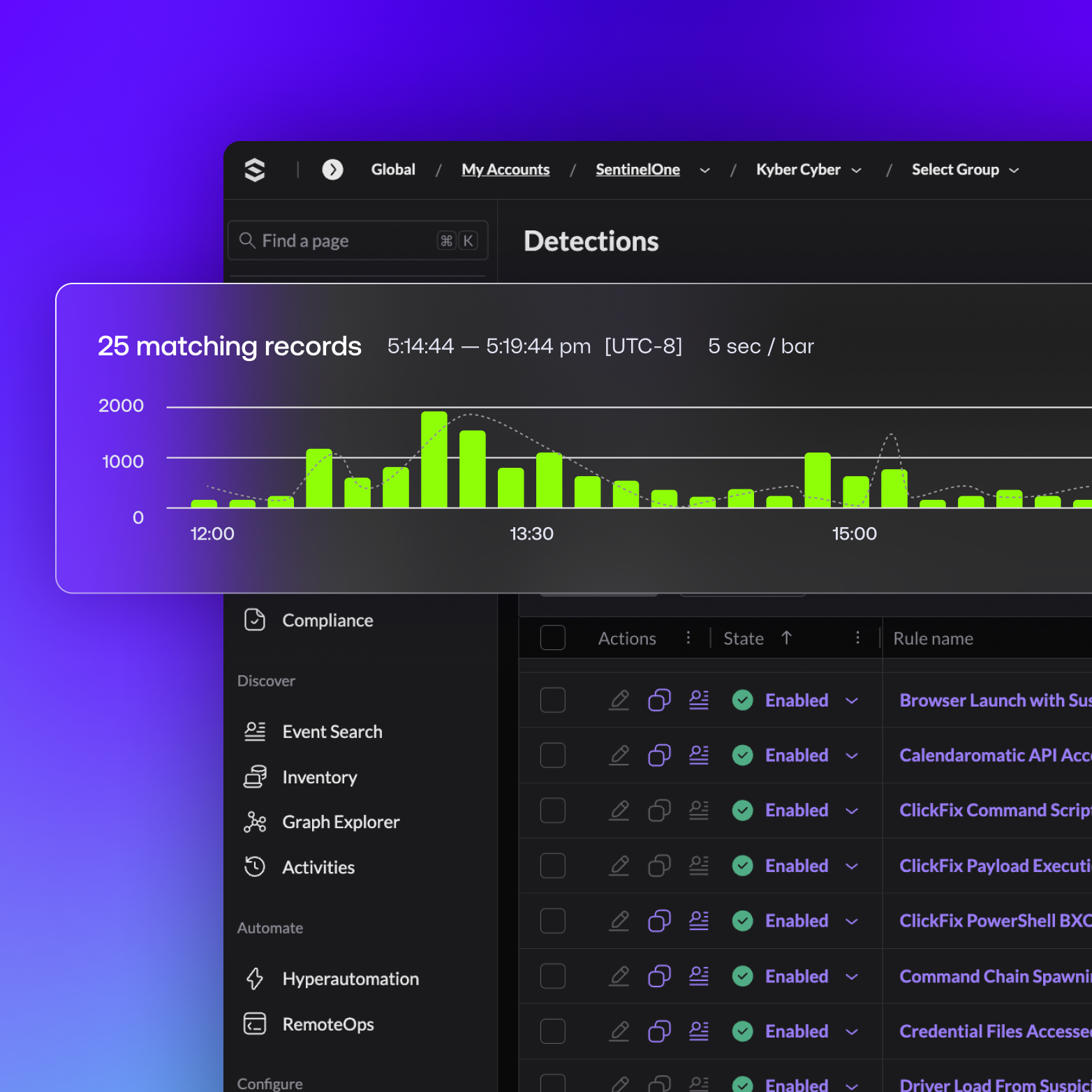
SentinelOne’s Singularity Data Lake ingests telemetry not just from endpoints but from cloud environments, identity providers, network infrastructure, and third-party security tools. The platform supports 300+ native integrations via its marketplace.
Data retention is configurable (up to 365 days on enterprise tiers) and the lake supports hot query performance even across large data volumes. For XDR use cases, this matters enormously — you need data available and queryable when you’re hunting, not archived somewhere slow.
Comparison with CrowdStrike: Falcon’s Humio-powered data platform (now Falcon LogScale) is a genuine competitor and arguably superior in raw ingestion speed and scalability at extreme data volumes. CrowdStrike’s 2021 Humio acquisition gave it a technology edge in log management. For very large enterprises with complex SIEM replacement needs, Falcon LogScale is the more mature option. For mid-market to upper-enterprise, SentinelOne’s Data Lake is fully competitive.
6. Identity Security (Singularity Identity)
SentinelOne acquired Attivo Networks in 2022 for approximately $617 million, integrating active directory protection, identity threat detection, and deception technology into the platform.
Singularity Identity monitors AD for misconfigurations, detects credential-based attacks (pass-the-hash, Kerberoasting, DCSync), and can deploy honeypot accounts and fake AD objects to lure attackers. The deception capability is legitimately sophisticated — it’s not bolted-on.
Comparison with CrowdStrike: CrowdStrike’s Falcon Identity Protection is similarly strong, drawing on its massive threat intelligence base to contextualize identity-based attacks. Both are credible. CrowdStrike’s integration of identity data with its broader adversary intelligence gives it a slight edge in contextualizing nation-state and criminal group TTPs around identity abuse.
7. Cloud Security (Singularity Cloud)
Cloud workload protection covers VMs, containers, Kubernetes, and serverless functions. CWPP capabilities include runtime protection, vulnerability management, and agentless scanning options.
Comparison with CrowdStrike: CrowdStrike’s cloud security posture management (CSPM) via Falcon Horizon is more mature and widely deployed. CrowdStrike also has deeper AWS/Azure/GCP marketplace integration and more established enterprise reference customers in cloud-heavy environments. SentinelOne is catching up but this remains a relative weakness compared to Falcon.

You may also like