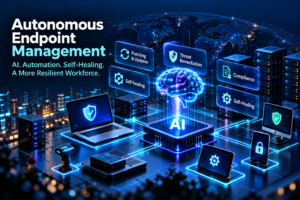
Endpoint management is moving beyond dashboards, scheduled patches and administrator-created automation.
The emerging concept is Autonomous Endpoint Management, or AEM: endpoint management platforms that combine telemetry, AI, automation and policy controls to detect endpoint problems, determine an appropriate response and execute or recommend remediation with substantially less administrator involvement.
This is no longer simply vendor terminology.
Gartner published dedicated research on Autonomous Endpoint Management in January 2025, describing AEM as a next-generation approach that brings intelligence-driven automation into endpoint management. Gartner’s 2027 Critical Capabilities for Endpoint Management Tools also evaluates Autonomous Endpoint Management as a distinct capability alongside UEM, security-centric management, frontline device management and other endpoint functions.
Adoption interest is also increasing. An Omdia survey of 364 IT and cybersecurity professionals conducted in July 2025 found that 50% were already using or piloting AEM while another 46% had plans or interest in deploying it.
Meanwhile, G2 now tracks 17 products in its Autonomous Endpoint Management category. Its analysis of 916 AEM reviews found that buyers are seeing genuine value from automated remediation, patching and endpoint intelligence, although the degree of autonomy varies significantly between products.
The result is a new buying question for IT leaders:
Which endpoint management platforms are actually becoming autonomous and which are simply adding AI features to traditional endpoint management?
The Cybersecurity Times evaluated five platforms that represent different approaches to this emerging market.
What Makes Endpoint Management “Autonomous”?
Traditional endpoint management gives administrators tools to discover, configure, patch and control endpoints.
Automation makes those tools faster by executing predefined tasks.
Autonomous endpoint management goes further.
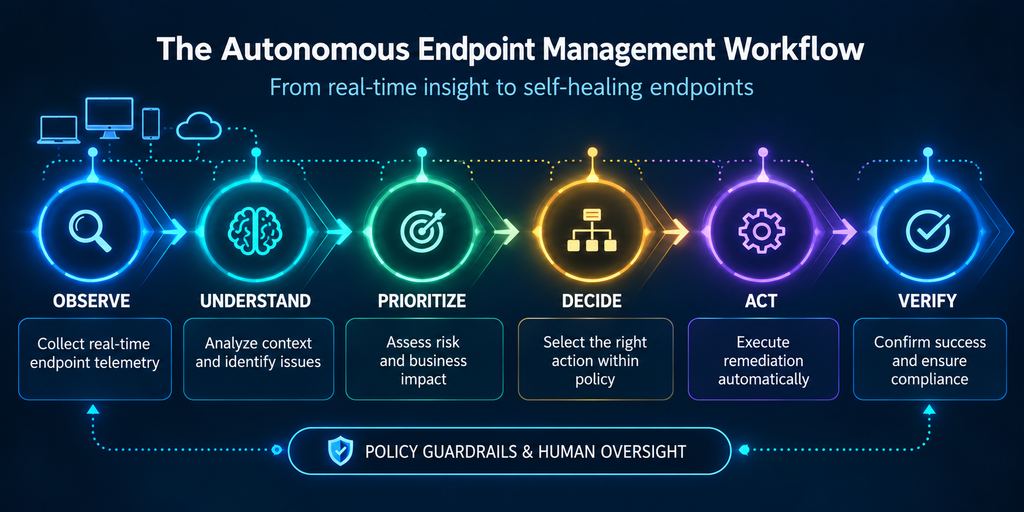
A mature AEM workflow should be capable of moving through a cycle resembling:
Observe → Understand → Prioritize → Decide → Act → Verify
For example, instead of merely informing an administrator that 2,000 devices require a critical update, an autonomous platform could identify the exposed devices, evaluate the vulnerability’s risk, determine which devices are ready for deployment, progressively deploy the update through controlled rings, detect failures, remediate problems and verify the resulting endpoint state.
Human oversight does not disappear.
In fact, governance becomes more important as endpoint platforms gain the ability to take action. Buyers should therefore evaluate not only how much a platform can automate but also how administrators define guardrails, approvals, rollback conditions and risk tolerances.
How We Evaluated the Platforms
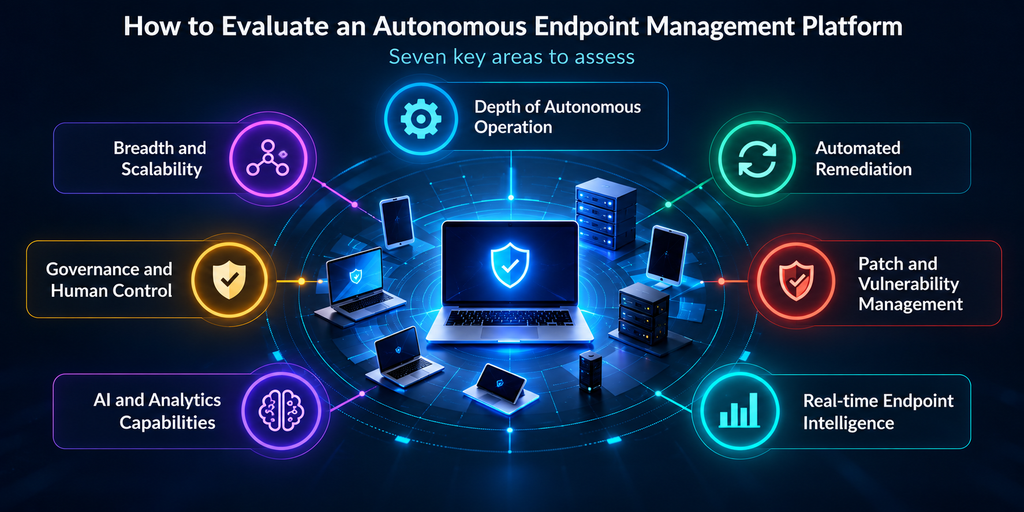
The Cybersecurity Times considered seven areas when evaluating the emerging AEM market: depth of autonomous operation, automated remediation, patch and vulnerability management, real-time endpoint intelligence, AI and analytics capabilities, governance and human control and the breadth and scalability of endpoint management.
This assessment is based on publicly available product documentation, vendor capabilities, analyst research and third-party user-review data available as of October 2026. It should not substitute for a technical proof of concept within an organization’s own environment.
No single platform is the best choice for every organization. Our selections therefore focus on buyer fit rather than declaring a universal winner.
1. Tanium
Best suited for: Large enterprises requiring real-time endpoint intelligence and autonomous operations
Tanium represents one of the more ambitious interpretations of Autonomous Endpoint Management.
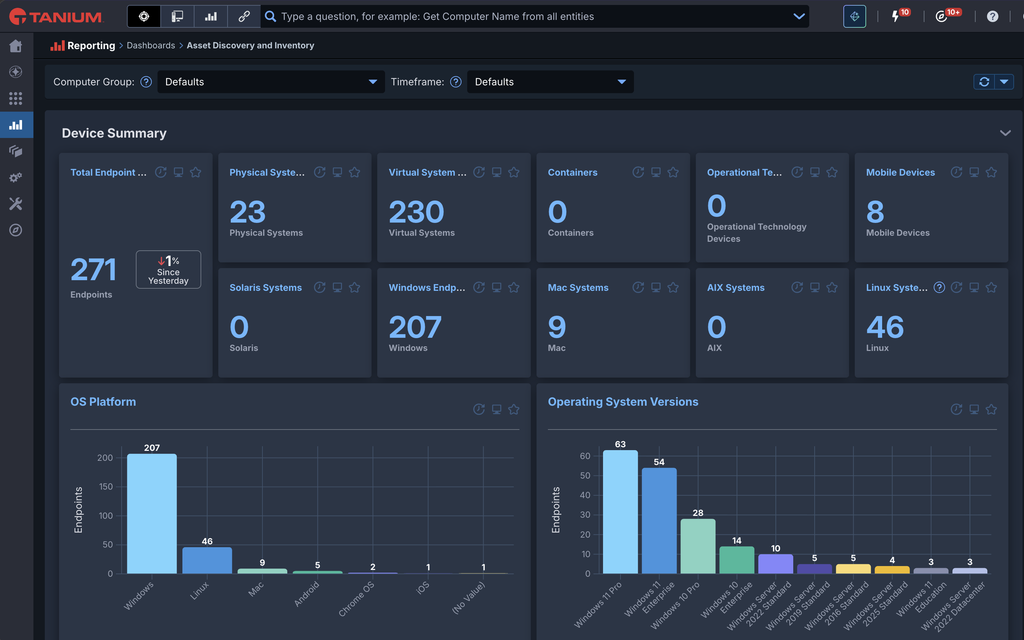
Its endpoint management architecture combines real-time endpoint telemetry with configuration management, software deployment, vulnerability remediation and increasingly autonomous patch operations.
Tanium positions real-time endpoint intelligence as the foundation of its autonomous model. Administrators can use current endpoint state and risk information to determine whether endpoints are ready for action rather than relying primarily on periodic scans.
Its autonomous patch management capabilities add another layer. Tanium uses endpoint information, vulnerability data and what it calls Confidence Scores to help assess patch readiness and deployment risk. Ring-based deployment can then progressively move changes through the environment.
This combination is particularly relevant for large organizations where applying the same automated action to tens of thousands of endpoints can create operational risk.
G2’s 2026 analysis of AEM reviews also found Tanium receiving particularly strong buyer recognition for the sophistication of its autonomous architecture and remediation capabilities, although reviewers also identified implementation and usability complexity.
Where Tanium stands out
Real-time intelligence + autonomous action
The differentiator is not simply automation. Tanium’s architecture attempts to base actions on current endpoint state, giving IT teams greater context before executing changes across large environments.
Potential consideration
That enterprise depth can also mean additional operational complexity. Organizations should evaluate implementation effort, platform administration requirements and whether their endpoint scale warrants that level of capability.
TCT assessment
Tanium is particularly compelling for large enterprises where endpoint visibility, security operations and large-scale remediation need to operate from the same real-time information layer.
2. Ivanti Autonomous Endpoint Management
Best suited for: Organizations seeking self-healing, risk-based patching and broader endpoint lifecycle automation
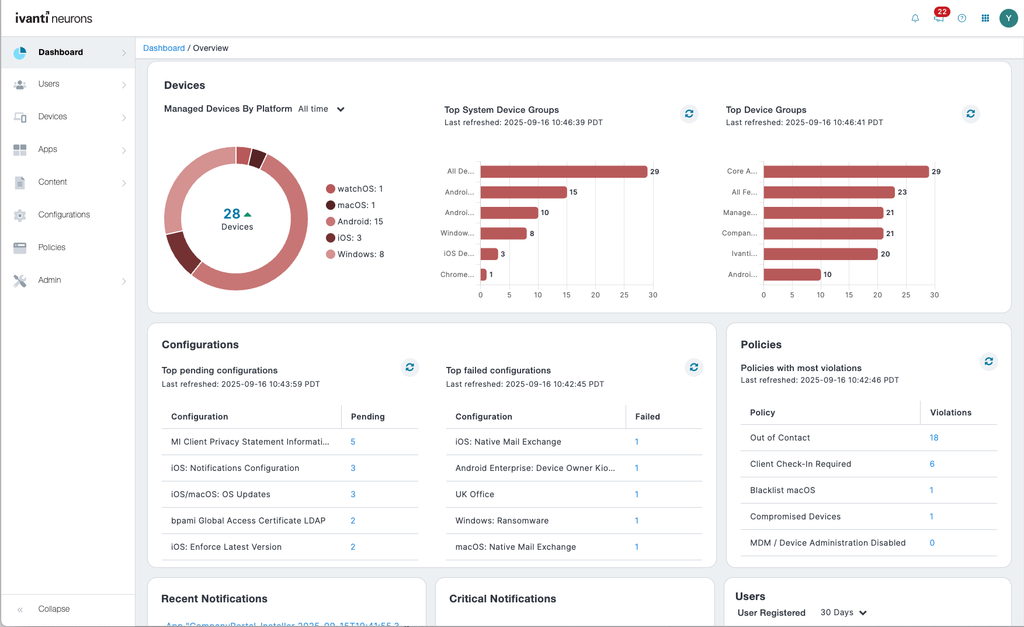
Ivanti has moved aggressively from conventional UEM toward a broader Autonomous Endpoint Management strategy through the Ivanti Neurons platform.
Its AEM approach combines device and software visibility, autonomous remediation, digital employee experience intelligence, patch management, compliance and automation.
A notable element is self-healing.
Ivanti uses automated workflows and bots to identify recurring endpoint conditions and remediate them without requiring a technician to manually address every incident. Examples include device health issues, configuration problems and routine support conditions.
Patch management follows a similar model.
Ivanti’s autonomous patch architecture brings together endpoint inventory, vulnerability risk, patch state and compliance information. The platform can prioritize vulnerabilities by risk and automate staged deployments across Windows, macOS, Linux and supported third-party applications.
Gartner Peer Insights currently describes Ivanti Autonomous Endpoint Management as supporting discovery, configuration, security, monitoring and remediation across Windows, macOS, Linux and mobile environments.
Where Ivanti stands out
Connecting endpoint management with self-healing and employee experience
AEM should eventually prevent endpoint problems rather than simply resolve them faster. Ivanti’s combination of DEX signals, endpoint telemetry and remediation makes that use case particularly interesting.
Potential consideration
Breadth can introduce complexity. Organizations evaluating Ivanti should test configuration, administration, agent reliability and the interaction between individual Neurons capabilities during their proof of concept.
TCT assessment
Ivanti is a strong candidate for enterprises attempting to evolve an established UEM environment into proactive and increasingly self-healing endpoint operations.
3. ManageEngine Endpoint Central
Best suited for: Organizations seeking broad UEM capabilities with an incremental path toward autonomous operations
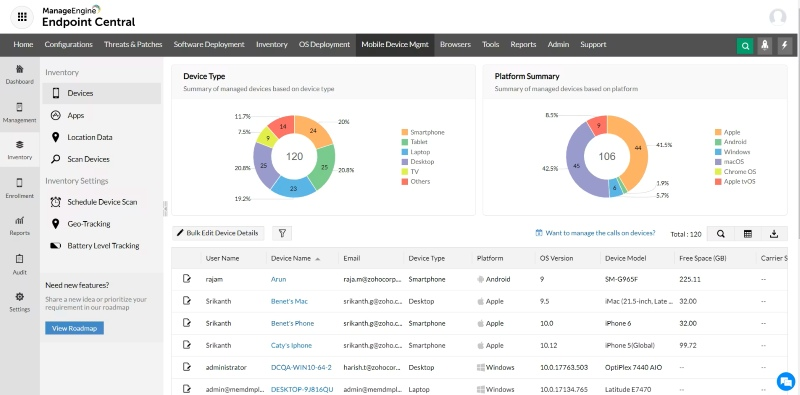
ManageEngine Endpoint Central takes a different route into AEM.
Rather than creating autonomy as an isolated endpoint product, ManageEngine is extending its existing UEM, endpoint security and digital employee experience capabilities with an AI execution layer.
Its current AEM architecture combines three major components: Endpoint Central as the management foundation, endpoint telemetry and data correlation as the intelligence layer and Zia agents as an AI-driven execution layer.
The platform can monitor configuration state and compliance baselines then identify drift and initiate corrective actions. ManageEngine is also applying autonomy to patching through risk scoring, patch reliability data, test rings and progressive rollout.
One particularly relevant design choice is its approach to human oversight.
For certain autonomous workflows, Endpoint Central can prepare and risk-score an action while still requiring administrator approval before production execution. That approach may appeal to organizations that want AI-assisted endpoint operations without immediately giving software agents unrestricted authority over production devices.
The platform’s breadth is another consideration. Endpoint Central combines traditional UEM functions with endpoint security, vulnerability remediation, DEX, OS deployment, application management and other capabilities.
Where ManageEngine stands out
A gradual route from UEM to autonomy
Organizations do not necessarily need to jump directly from human-managed endpoints to fully autonomous operations. Endpoint Central provides a model where automation, intelligence and autonomous workflows can coexist with administrator approval.
Potential consideration
Buyers should distinguish between capabilities available today and functions identified as forthcoming within the broader AI roadmap. They should also test how consistently AI-assisted workflows work across the operating systems and device types important to their environment.
TCT assessment
Endpoint Central is particularly interesting for organizations wanting broad endpoint management coverage while progressively increasing the level of automation and AI-driven remediation.
4. NinjaOne
Best suited for: IT teams prioritizing operational simplicity and autonomous patch management
NinjaOne approaches the autonomous endpoint market from an IT operations perspective.
Its platform combines endpoint management, remote support, software deployment, monitoring and patching with an increasing focus on AI-driven patch intelligence and autonomous patch deployment.
NinjaOne’s current patch architecture supports Windows, macOS and Linux alongside thousands of applications. Its Patch Intelligence AI helps evaluate updates while policies determine how and when patches are deployed.
G2 currently includes NinjaOne among the defining products in its Autonomous Endpoint Management theme and its AI-powered IT automation category.
That positioning is important because not every organization requires the same level of autonomous sophistication.
A smaller IT team managing thousands of distributed endpoints may benefit more from reliable automation that eliminates repetitive administration than from a highly sophisticated autonomous decision engine requiring substantial operational design.
Where NinjaOne stands out
Reducing everyday endpoint administration
NinjaOne’s strength is its ability to combine endpoint management workflows with extensive automation while maintaining a comparatively straightforward operational model.
Potential consideration
Organizations looking for advanced autonomous decision-making across security, digital experience, configuration and endpoint operations should compare the breadth of NinjaOne’s autonomous capabilities with platforms such as Tanium and Ivanti.
TCT assessment
NinjaOne should be high on the shortlist for organizations where the primary objective is reducing routine endpoint-management workload without adding another highly complex enterprise platform.
5. Action1
Best suited for: Security-focused organizations prioritizing autonomous patching and vulnerability remediation
Action1 illustrates why the definition of AEM matters.
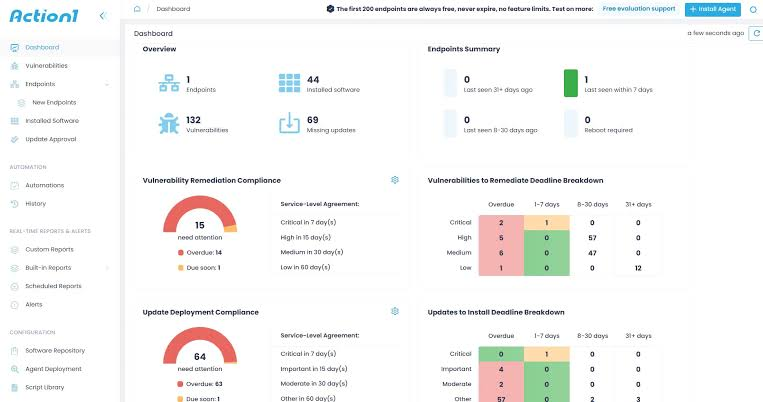
It does not attempt to replicate every capability of a broad UEM platform. Instead, its strongest autonomous capabilities concentrate on one of the most consequential endpoint problems: finding vulnerabilities and closing them through patching and remediation.
Action1 combines vulnerability discovery, risk prioritization, patch management, software deployment, endpoint inventory and remediation within a cloud-native platform.
Its autonomous patching capabilities cover Windows, macOS and supported Linux environments along with third-party applications. Administrators can define policies, approval requirements, deployment schedules and maintenance windows while the platform manages execution and verifies results.
G2’s analysis of 2026 AEM reviews identified patch management as one of the category’s most mature capabilities and highlighted Action1 particularly strongly for patching.
Where Action1 stands out
Closing the gap between vulnerability discovery and remediation
Many security environments can identify vulnerabilities faster than IT teams can remediate them. Action1’s value proposition centers on reducing that gap by connecting vulnerability context directly with endpoint action.
Potential consideration
Organizations requiring extensive mobile device lifecycle management, sophisticated DEX capabilities or very broad UEM functionality should compare Action1’s scope against broader endpoint platforms.
TCT assessment
Action1 is a compelling choice for buyers whose AEM strategy begins with autonomous vulnerability remediation and patch management rather than full endpoint lifecycle transformation.
Autonomous Endpoint Management Solutions Comparison
Autonomous Endpoint Management Solutions 2027
Five leading approaches to endpoint autonomy, compared by core strength, autonomy model and ideal buyer fit.
| Platform | Best At | Autonomy Model | Ideal Buyer | Positioning |
|---|---|---|---|---|
 TaniumEnterprise Intelligence |
Real-time visibilityLarge-scale remediation and enterprise patching | Telemetry-driven autonomy | Large enterprisesComplex, highly distributed endpoint estates | Advanced |
 IvantiSelf-Healing Operations |
Self-healing endpointsDEX, remediation and risk-based patching | Detect → Remediate → Verify | Enterprise IT teamsProactive endpoint and employee-experience operations | Advanced |
 ManageEngineEndpoint Central |
Broad UEM + AI workflowsEndpoint security, automation and governed remediation | AI-assisted governed execution | Mid-market & enterpriseTeams progressing from UEM toward autonomy | Strong |
 NinjaOneOperational Simplicity |
IT operations & patchingUsability, automation and endpoint administration | Policy automation + AI assistance | Lean IT teamsDistributed environments and lighter operations teams | Strong |
 Action1Autonomous Remediation |
Vulnerability remediationAutonomous patching and exposure reduction | Policy-controlled remediation | Security-focused IT teamsPatch-first AEM strategies and exposure reduction | Strong |
Other AEM Platforms Worth Watching
The market is developing quickly and the five platforms above do not represent every credible option.
Automox is increasingly positioning its cloud-native platform around Autonomous Endpoint Management. It combines policy-driven cross-platform patching, configuration and remediation with Worklets that can address configuration changes and vulnerabilities for which conventional patches are unavailable.
G2’s AEM taxonomy also includes or highlights products such as Atera, HCL BigFix, PDQ Connect and Splashtop Autonomous Endpoint Management, illustrating how quickly established endpoint vendors are moving toward autonomous capabilities.
Expect this list to change.
AEM vs UEM: What’s the Difference?
UEM and AEM are not necessarily competing product categories.
UEM answers:
How do we centrally manage our endpoint estate?
AEM increasingly answers:
How much of that management can the platform perform intelligently without requiring an administrator to initiate every action?
A mature UEM platform can therefore become the foundation for AEM.
The difference is the operating model.
Traditional endpoint management typically follows:
Detect → Alert administrator → Investigate → Decide → Execute
Autonomous management attempts to compress that process:
Detect → Understand → Decide within policy → Remediate → Verify
Administrators move from executing individual endpoint actions toward defining policies, risk tolerances and governance boundaries.
That change may ultimately be more significant than the addition of AI itself.
How to Evaluate an Autonomous Endpoint Management Platform
Do not ask a vendor only whether its product includes AI.
Ask what the AI is permitted to do.
A useful AEM evaluation should determine whether the platform can identify an endpoint condition automatically, understand the context surrounding it, select an appropriate remediation, execute the action within administrator-defined rules, validate that the action worked and safely recover if it did not.
Buyers should also examine whether autonomous capabilities work across their actual device estate rather than only in a product demonstration.
An organization running Windows laptops, macOS devices, Linux servers, mobile devices, frontline hardware and remote endpoints may discover very different levels of autonomy across each category.
Finally, determine where the human remains in the process.
Autonomy without governance is not a feature. It is a risk.
Is Autonomous Endpoint Management Ready for Enterprise Adoption?
In some areas, yes.
Automated patching, vulnerability remediation, configuration enforcement and routine endpoint maintenance are already relatively mature AEM use cases.
Fully autonomous endpoint operations are less mature.
G2’s research suggests that buyers are seeing meaningful results from AEM but also shows that the degree of autonomy differs substantially between platforms.
TechTarget similarly cautions that enterprises need to distinguish genuine autonomous capability from traditional automation being repositioned around AI.
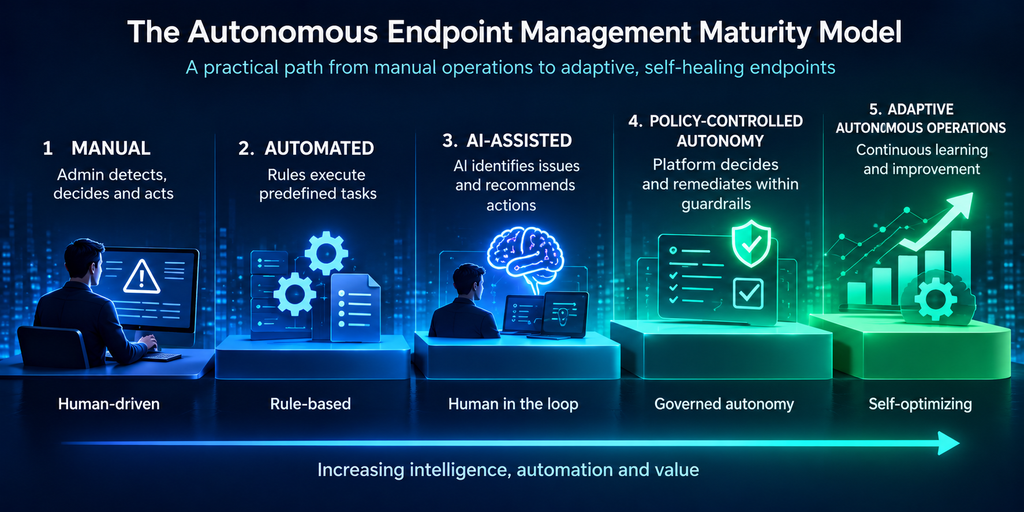
For most organizations, the practical path is therefore unlikely to be an overnight transition to completely autonomous IT.
It will be a progression:
Manual → Automated → AI-assisted → Policy-controlled autonomy → Adaptive autonomous operations
The Cybersecurity Times View
Autonomous Endpoint Management looks increasingly likely to become an important evolution of the endpoint management market.
Gartner research has already formalized AEM as a distinct endpoint-management capability while buyer-review platforms such as G2 have begun treating it as its own software category. Adoption research also suggests that enterprise experimentation is already well underway.
But buyers should be cautious with the word autonomous.
A chatbot attached to an endpoint console does not make a platform autonomous.
Neither does scheduled patching.
The platforms that will define this market will be the ones capable of reliably connecting endpoint intelligence, decision-making, policy, execution and verification while giving organizations precise control over how much authority they delegate to software.
For buyers, that creates a better question than simply asking:
“Does this endpoint platform have AI?”
Ask instead:
“Which endpoint decisions can this platform safely make and execute without my team?”
The answer reveals far more about how autonomous the platform really is.
Frequently Asked Questions
What is Autonomous Endpoint Management?
Autonomous Endpoint Management is an approach to endpoint operations that combines endpoint telemetry, AI, automation and policy controls to identify, prioritize and remediate endpoint conditions with reduced human intervention.
What is the difference between AEM and UEM?
UEM centralizes device management. AEM builds on endpoint-management capabilities by adding intelligence and automated decision-making so that some endpoint actions can be detected, initiated, executed and verified automatically.
What are the leading Autonomous Endpoint Management solutions in 2027?
The Cybersecurity Times identifies Tanium, Ivanti Autonomous Endpoint Management, ManageEngine Endpoint Central, NinjaOne and Action1 as five notable platforms to evaluate. The best option depends on endpoint scale, operating-system mix, security requirements and the level of autonomy an organization is prepared to implement.
Can Autonomous Endpoint Management replace IT administrators?
No. AEM changes the administrator’s role rather than eliminating it. IT teams increasingly define policies, approvals, risk thresholds and exception handling while automation handles repetitive execution.
Is autonomous patch management the same as AEM?
No. Autonomous patching is one component of AEM. Broader AEM can include endpoint discovery, configuration, vulnerability remediation, compliance enforcement, digital employee experience, software management, security operations and self-healing workflows.
Is AEM the same as endpoint security or EDR?
No. Endpoint security products primarily detect and stop threats. AEM focuses on managing the operational state, configuration, health and remediation of endpoints. The categories increasingly overlap as endpoint management and endpoint security platforms converge.
Editorial note: Product capabilities and AI functionality are changing rapidly. This analysis reflects publicly available information as of October 2026. Organizations should validate platform capabilities through a proof of concept before making purchasing decisions.

You may also like